
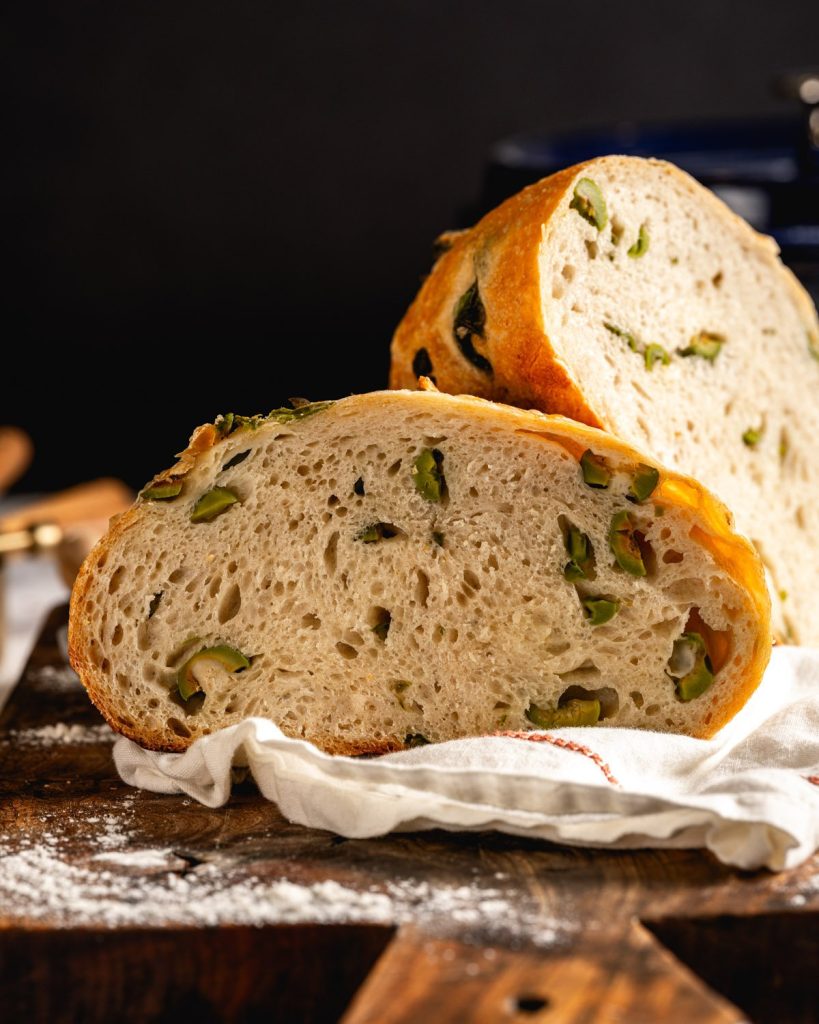
This no knead olive bread recipe tastes like it’s from a bakery but it’s so easy to make at home! It has a deliciously crispy crust, soft and chewy interior, and developed, savory flavor. Everyone will be singing its praises (every time we make it, our family can’t stop eating it).
As two professional recipe developers and cookbook authors, Alex and I always urge home cooks to learn one skill: homemade bread! There’s really nothing like pulling a golden brown loaf from the oven (the aroma in your kitchen alone is worth it!).
Here’s a bread recipe that we are head over heels for: this no knead olive bread recipe! It’s inspired by our trip to France this summer, but you can easily whip it up at home using this recipe. Every time we make this for family, everyone keeps exclaiming how good it is! Here’s everything you need to know about making olive bread at home.
How to make olive bread: an overview
Here’s the basic outline of the tasks for this olive bread recipe. The process takes 5 minutes the night before, and then about 2 hours the day of. While you do need to think ahead for the rest, this bread recipe is so much easier than our sourdough bread and or artisan bread recipe. In fact, it’s the quickest and easiest bread method we have. Here’s an outline of what you’ll have to do:
| Mix, Rest overnight | 5 minutes active, 12 to 18 hours hands off |
| Shape & proof | 5 minutes active, 1 hour hands off |
| Bake | 45 minutes, hands off |
| Cool | 45 minutes, hands off |
Making no knead bread requires a few tools. It’s easiest to make with a Dutch oven, but you can also use a pizza stone. There are several optional tools as well that make things easier, but are not required. Here’s what you need!
- Large Dutch oven: Baking bread in a covered Dutch oven holds in the steam that the bread releases as it cooks. This makes an extra crispy crust and perfect rise. If you don’t have a Dutch oven, you can use a pizza stone.
- Parchment paper: You’ll use parchment paper inside the Dutch oven to prevent sticking while baking.
- Lame or knife: A lame or sharp knife is used for scoring the bread.
- Kitchen scale: The best way to make bread is weighing the dry ingredients, which makes the most accurate measurements (we use this kitchen scale).
Dutch oven vs pizza stone
A Dutch oven is a heavy cooking pot with a lid used for braising meat and making soups and stews. You can use it on the stovetop or in the oven. All Dutch ovens are made of cast iron; some have an enamel coating that makes them easier to clean.
The Dutch oven that we use for bread is Lodge 6 Quart Cast Iron Dutch oven. Since it holds in the steam, it makes for the best crispy crust while baking. You can also use a Dutch oven for making soups, stews and more: go to our top Dutch oven recipes.
As an alternative, you can a pizza stone to bake this no knead bread! You’ll also have to create extra steam in your oven using a baking sheet and pouring boiling water onto it when you add the bread. This creates steam, which makes that crispy crust. Here’s the pizza stone we recommend. (Of course, you can also use it for our popular pizza dough recipe and all our pizza recipes!)

The flours for olive bread
For this olive bread recipe, we use a mixture of all-purpose flour (for texture) and bread flour (for strength). We find that this mix makes a moderately open crumb (those beautiful holes in the interior), a chewy crust, and tangy flavor.
Personally, we use King Arthur brand organic flour. In testing many different flours, we find it has the best and most consistent results for homemade bread recipes.
A note on olives
You can use any olives you like in this recipe: including green, black or purple olives. We like Castelvetrano olives: they’re a green olive variety grown in Sicily with a mild and fruity flavor that doesn’t overpower the bread. But you can use any type you like: Kalamata olives, black or green olives, etc.

Why the overnight rest?
This olive bread recipe requires thinking ahead 1 day: you’ll need to rest the bread dough overnight. If you’re like us, you might have trouble with thinking ahead and wonder if you can skip this step. Unfortunately, it’s essential to this recipe! Here’s why:
- No knead bread requires only 1 proof. Proofing is letting the bread stand at room temperature while the leavener (in this case, yeast) does its magic to help the bread rise. Usually a proof is about 45 minutes to 1 hour. Both our sourdough bread and artisan bread require folding and “proofing” the bread multiple times. So doing only 1 proof for homemade bread is almost unheard of!
- The tradeoff is resting overnight. Proofing requires a lot of time and effort to fold and proof multiple times. So to shortcut it, you can rest the bread at room temperature overnight. To us, that’s a very worthy tradeoff! You save hours of bread making time the day of baking.
How to shape the boule
The main part of making olive bread that requires technique is shaping the dough. You’ll shape it into a ball, called a boule. It’s easiest to learn how to shape the dough by watching. Here’s a video instruction for shaping the boule.

How to score the bread
The lines on top of a beautiful loaf of bread are called score lines. Scoring is slashing the top of the dough with a sharp knife to allow it to expand when baking. Here are a few tips for scoring no knead bread:
- Use your sharpest knife or a lame. You’ll want the knife to be ultra sharp. We purchased a lame for this (pronounced “lahm”) since we make lots of bread recipes—but it’s totally optional.
- Make shallow cuts into the top of the dough. You want to cut just the surface — if it’s too deep it collapses, if it’s too shallow it bursts.
Storing leftovers (important)
Storing homemade bread is different from store-bought, since it has no preservatives. There’s also an important thing to keep in mind:
- Do not store in plastic! Placing homemade bread in plastic makes it soggy and ruins the crispy crust. Make sure to store it wrapped in cloth: a towel or a bread bag!
- Store at room temperature 2 days: Once you’ve baked your olive bread, it is best eaten within 48 hours. We store ours wrapped in cloth at room temperature. Use a clean dish towel or a bread bag.
- Or, freeze up to 3 months: You can also freeze olive bread. It’s easy to cut your bread in half and freeze half of it! Let it cool to room temperature, then cut it into slices and place it into a sealed bag or container.
Dietary notes
This olive bread recipe is vegetarian, vegan, and plant-based.
Olive Bread (No Knead)

This no knead olive bread recipe tastes like it’s from a professional bakery but it’s so easy to make at home! It has a deliciously crispy crust, soft and chewy interior, and developed, savory flavor. Everyone will be singing its praises (every time we make it, our family can’t stop eating it).
- Prep Time: 1 hour 30 minutes (plus overnight)
- Cook Time: 45 minutes
- Total Time: 2 hours 15 minutes
- Yield: 12 to 14 slices 1x
- Category: Bread
- Method: Baked
- Cuisine: French
- Diet: Vegan
- 2 ½ cups bread flour (350 grams)
- 1 cup all purpose flour (140 grams)
- 1 teaspoon instant or active dry yeast
- ½ tablespoon kosher salt (9 grams)
- 1 ½ cups lukewarm water (354 grams)
- 1 cup pitted green olives, (dry weight 5.6oz) sliced, and dried (we used Castelvetrano olives)
- Mix the dough (night before): Roughly slice and pat dry the olives. In a large bowl, stir together the bread flour, all-purpose flour, yeast and salt. Add the warm water and olives. Stir with a wooden spoon or dough whisk until all flour is incorporated and olives are evenly distributed. Cover tightly and rest 12-18 hours (overnight) at room temperature.
- Shape the dough: When ready to bake, remove the dough from the bowl onto a clean, lightly-floured countertop. With wet hands, place your hands behind the dough and gently pull the dough towards you to increase the tension on the surface of the dough. Rotate and repeat until you have a boule shape, being careful not to tear the dough where olives are near the surface.
- Rest 1 hour: Place the boule on a piece of parchment paper about twice the width of the boule. Cover the dough with an inverted large bowl and rest for 60 minutes.
- Preheat the oven: Preheat the Dutch oven (with lid) at 450°F for 30 minutes.
- Score the bread: Use a sharp knife or lame to cut a shallow slit at a slight angle across the top of the dough.
- Bake in a Dutch oven for 17 minutes at 450°F: Working quickly and carefully with oven gloves or mitts, transfer the dough on the parchment paper to the preheated Dutch oven, then place the top on. Bake for 17 minutes.
- Reduce to 400°F and bake for 27 to 30 minutes on oven rack: Reduce the oven temperature to 400°F. Remove the Dutch oven, carefully take out the bread, and set the bread directly onto the oven rack (without the parchment). Bake for an additional 25 to 27 minutes, until hollow when tapped or internal temperature is at 205 to 209 Fahrenheit.
- Cool and enjoy: Remove the bread from the oven and allow it to cool on a cooling rack for at least 45 minutes. After cooling, the bread is ready to eat.
- Storage info: Store the olive bread wrapped in cloth or in a bread bag on the counter for up to 2 days (do not store in plastic or it becomes soggy!). Alternatively, you can freeze (sliced) wrapped in foil in a plastic bag for several months. This loaf is perfect for serving with cheese, as a base for bruschetta, or simply enjoyed on its own. Enjoy!